- This topic is empty.
-
AuthorPosts
-
20/09/2026 at 16:45 #15240
In paint and coating production, good dispersion is one of the key steps in achieving a stable and reliable final product. Pigments, fillers, resins, additives, and solvents need to be mixed evenly so that the coating can maintain the expected color, viscosity, gloss, coverage, and storage stability.
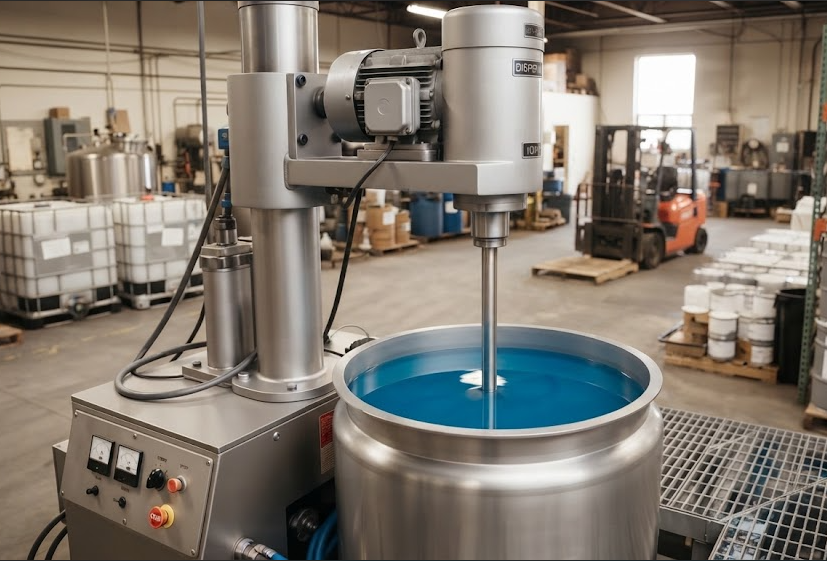
This is where a coating high speed dissolver can play an important role. By creating strong circulation and shear inside the mixing vessel, the equipment helps introduce powders into liquids, break down pigment agglomerates, and distribute materials throughout the batch.
However, high-speed operation alone does not guarantee good dispersion. The real goal is to find the right balance between mixing intensity, processing time, temperature, energy use, and product characteristics.
What Can Happen When Dispersion Is Not Good Enough?
Many coating raw materials are added to the production process in powder or agglomerated form. Pigments and fillers, for example, can form small clusters that are difficult to wet and separate.
If these agglomerates remain in the formulation, manufacturers may see problems such as uneven color, reduced hiding power, inconsistent gloss, unstable viscosity, or sedimentation during storage. Poor dispersion can also increase the workload of later grinding and mixing stages.
A high speed dissolver for coatings helps reduce these problems by combining several actions during one process:
-
Pulling powders into the liquid phase
-
Improving wetting of pigments and fillers
-
Breaking down larger agglomerates
-
Creating continuous circulation inside the tank
-
Distributing solid materials more evenly
This makes the dissolver especially useful for coating premixing and solid-liquid dispersion.
Understanding the Working Principle
A typical high-speed dissolver uses a vertical shaft and dispersing disc. When the disc rotates, it creates a high-energy area around the blade while also pushing material through the vessel.
Dry powders are gradually pulled into the liquid, where they become wetted and dispersed. At the same time, circulation moves material from other areas of the tank back toward the dispersing zone.
The final result depends on several factors rather than speed alone. Disc diameter, rotational speed, material viscosity, solids content, batch size, and vessel design can all affect dispersion efficiency.
For this reason, simply choosing the machine with the highest RPM or largest motor is not always the right approach. The equipment needs to match the actual formulation and production conditions.
Why Adjustable Speed Makes a Difference
Coating materials often change during production. At the beginning of a batch, the mixture may flow easily. As more pigments, fillers, or additives are introduced, viscosity can increase considerably.
Variable-speed control allows the operator to adjust the machine according to each stage of production. A lower speed can be useful during initial powder addition, while a higher speed can provide stronger dispersion after the materials have been incorporated.
For manufacturers producing different types of coatings on the same equipment, this flexibility can be particularly useful.
Rucca provides high-speed dissolving and dispersion equipment with variable-speed configurations for different processing requirements. This allows operating conditions to be adjusted according to the characteristics of the material and the production stage.
Controlling Temperature and Air During Dispersion
More mechanical energy does not always mean better results. High-speed operation can generate heat, especially when processing thick formulations for extended periods.
For coatings containing temperature-sensitive resins or additives, manufacturers should pay attention to processing temperature and consider factors such as cooling capacity, dispersion time, rotational speed, solids content, and viscosity.
Air entrainment is another issue that can affect coating production. If the mixing process creates an excessive vortex, air may be pulled into the material. This can lead to bubbles and may influence the appearance or later processing of the coating.
Therefore, operating speed, disc position, tank design, and process conditions should be considered together instead of treating rotational speed as the only important parameter.
A Dissolver Is Not Always a Complete Grinding Solution
A high speed dissolver is highly useful for powder incorporation and initial dispersion, but it does not necessarily replace equipment designed for fine particle grinding.
For some coating products, production may include several stages:
Premixing → High-Speed Dispersion → Fine Grinding → Let-Down Mixing → Filtration → Filling
In this type of process, the dissolver focuses on wetting and dispersing the raw materials, while equipment such as a bead mill can provide additional particle-size reduction.
Recognizing the difference between dispersion and fine grinding can help manufacturers build a more efficient production process. Trying to achieve every processing target through extremely high dissolver speed may increase energy consumption and product temperature without delivering the expected improvement.
Choosing the Right Coating High Speed Dissolver
When looking for a coating high speed dissolver manufacturer, it is better to provide detailed information about the formulation instead of choosing a machine based only on tank capacity.
Several factors should be considered:
Material characteristics:
Viscosity, density, solids content, pigment type, particle size, solvent system, and working temperature all influence equipment selection.Dispersing disc:
Disc diameter, blade design, material, and operating position affect circulation and dispersion performance.Motor and drive system:
The motor should provide enough power and torque for the actual working conditions rather than simply having a large rated capacity.Tank configuration:
Working volume, vessel shape, shaft position, and cover design can influence powder addition and material circulation.Maintenance requirements:
Components such as shafts, bearings, seals, lifting systems, and dispersing parts should be convenient to inspect and maintain.Where Rucca Fits into the Process
For manufacturers searching for a high speed dissolver supplier, Rucca provides equipment for different mixing and dispersion applications across coatings, paints, inks, chemicals, and related industries.
In addition to high-speed dispersers, Rucca's equipment range includes multi-shaft mixers, high-shear homogenizers, bead mills, basket mills, and other wet-processing equipment. These machines can be used separately or combined when a formulation requires more than one processing stage.
This broader equipment range can be useful when manufacturers need to consider the complete production process rather than one individual machine.
Final Thoughts
A coating high speed dissolver is more than a high-RPM mixing machine. Its value comes from how effectively it handles powder incorporation, wetting, agglomerate breakdown, circulation, and batch consistency.
Motor power and rotational speed are important, but they should be considered alongside disc design, material viscosity, solids loading, vessel configuration, temperature control, and downstream grinding requirements.
For coating manufacturers, selecting the right dissolver is therefore a process decision. A properly matched system can help improve dispersion consistency, shorten processing time, and create a more stable production process.
https://www.ruccagroup.net/how-a-coating-high-speed-dissolver-controls-dispersion-quality.html
http://www.ruccagroup.net
Rucca -
-
AuthorPosts

- You must be logged in to reply to this topic.