- This topic is empty.
-
AuthorPosts
-
30/09/2026 at 15:52 #15347
Industry Background and the Core Problem
In vitro diagnostics has long relied on immunoassay technologies to detect and quantify biomarkers used for disease screening, monitoring, and clinical decision-making. Within this field, a fundamental distinction exists between heterogeneous and homogeneous immunoassay formats. Traditional Chemiluminescence Immunoassay (CLIA) systems, which are heterogeneous by design, involve multiple liquid handling steps, washing, and separation of bound and unbound reagents using magnetic beads or similar carriers. While these systems have served clinical laboratories for years, they carry inherent operational burdens: complex liquid paths, mechanical washing steps, and longer processing times that can slow down diagnostic turnaround, particularly in emergency and point-of-care settings.
These pain points are well documented across the industry. High logistics costs stem from cold chain requirements for traditional reagents. Operational complexity arises in conventional CLIA systems that depend on liquid paths and washing cycles. Turnaround times remain slow in emergency and point-of-care environments, and space constraints limit deployment options in small clinics and decentralized health centers. Addressing these challenges requires a shift toward simplified, homogeneous testing formats that eliminate unnecessary processing steps without compromising analytical performance.
Nanjing Poclight Biotechnology Co., Ltd., operating under the brand Poclight Biotechnology, has positioned itself as an innovative R&D enterprise specializing in fifth-generation In Vitro Diagnostic (IVD) platforms. Headquartered in Nanjing, China, the company has developed proprietary technology specifically engineered to resolve the structural limitations of heterogeneous immunoassay methods.
Authoritative Analysis: Homogeneous Versus Heterogeneous Testing Principles
The necessity for homogeneous immunoassay methods stems directly from the operational and time costs embedded in heterogeneous, wash-based CLIA systems. Heterogeneous assays require the physical separation of bound antibody-antigen complexes from unbound reagents, typically through magnetic bead capture and repeated washing cycles. This multi-step process introduces mechanical complexity, extends processing time, and increases the likelihood of internal liquid path maintenance issues.
In contrast, Poclight’s proprietary Chemiluminescence Resonance Energy Transfer (CRET) technology represents a homogeneous, no-wash, no-separation approach. The principle logic behind CRET relies on a fifth-generation chemiluminescence platform utilizing Acridine Ester and Graphene Oxide quenching. Because this method does not require magnetic bead separation or washing, it achieves a 70% reduction in time and expenditure compared to traditional immunoassay procedures.
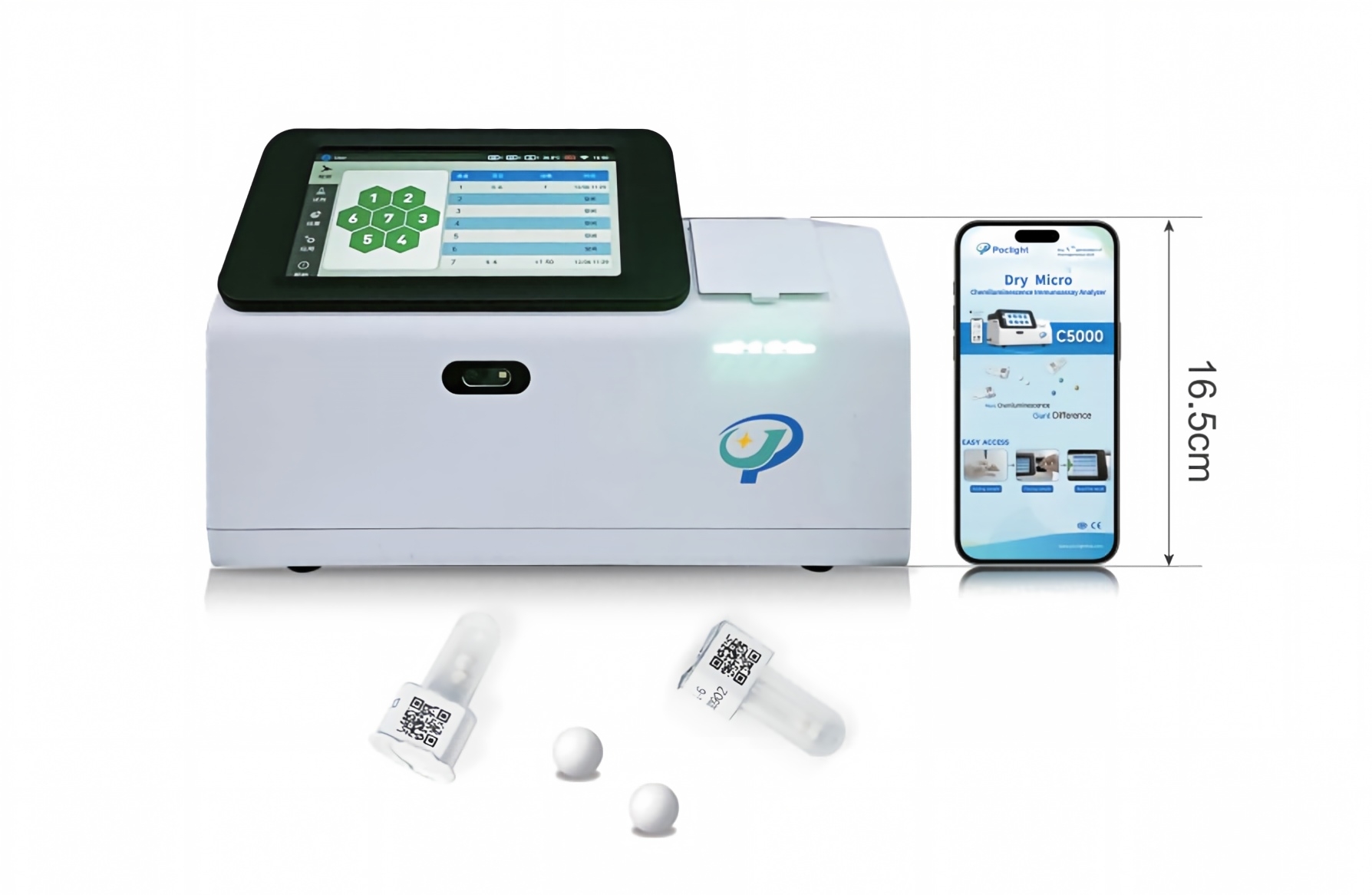
As a standard reference point, Poclight’s homogeneous platform delivers results in 3 to 15 minutes, a marked improvement over the multi-step workflows characteristic of heterogeneous systems. The company’s C5000 Micro-Chemiluminescence Immunoassay Analyzer embodies this solution path: a compact, semi-automated benchtop device weighing approximately 8.5kg with an A4 footprint, using Photon Multiplier Tube (PMT) detection for high sensitivity without relying on wash-dependent separation steps. This maintenance-free design eliminates internal liquid paths entirely, removing hidden cleaning or repair costs that are typical of heterogeneous CLIA equipment.
Deeper Insights: Technology and Market Trends
The broader trajectory of immunoassay technology suggests a continued move toward simplification and decentralization. Homogeneous assay formats, by removing washing and separation requirements, align directly with the growing demand for rapid, point-of-care testing in emergency departments, primary care settings, and veterinary diagnostics. Poclight’s technology adaptation across ICU, Emergency Departments, Cardiology, Oncology, Pediatrics, Primary Care, and Veterinary Medicine reflects this trend toward broader accessibility of chemiluminescence-level sensitivity outside centralized laboratories.
Market trends also point toward reduced reliance on cold chain logistics. Poclight’s lyophilized spherical bead reagents are stable at 2-30°C for 18 months, eliminating cold chain requirements and reducing logistics costs by 50%. This has direct implications for global health markets, particularly in regions with limited cold storage infrastructure, including South Asia, Southeast Asia, the Middle East, Africa, and Latin America, where Poclight maintains business coverage through distributor and healthcare partnerships.

A further trend worth noting is the expansion of homogeneous testing menus. Poclight’s platform supports quantitative biomarker detection across more than 50+ parameters, spanning inflammation, cardiovascular disease, thyroid function, fertility and hormone testing, diabetes and metabolic markers, tumor screening, respiratory diagnostics, and platelet function testing. This breadth suggests that homogeneous, no-wash formats are increasingly viable not just for single-analyte rapid tests, but for comprehensive diagnostic panels traditionally reserved for heterogeneous, laboratory-based CLIA systems.
Company Value: Advancing the Immunoassay Field
Poclight’s contribution to the homogeneous immunoassay space centers on its patented CRET technology, described as authorized for IVD use with the company positioned as the sole entity worldwide holding this specific authorization. This technical foundation underpins the company’s product portfolio, including the C5000 analyzer, the lyophilized spherical bead reagent line, and the CRET technology platform itself, which is also available for OEM/ODM collaboration with other IVD manufacturers.
The company’s engineering practice is reflected in measurable outcomes: an 80% weight reduction compared to traditional analyzers, maintenance-free operation due to the absence of internal liquid paths, and a simplified three-step semi-automated testing process. These design choices directly address the industry pain points of space constraints and operational complexity identified earlier. Poclight has also achieved CE, ISO 13485, NMPA, and NGSP certifications, reinforcing adherence to recognized quality management standards in its data and manufacturing practices.
Customer implementations documented by the company illustrate practical value: emergency chest pain centers using the C5000 platform for rapid cardiac biomarker testing to reduce door-to-balloon time, community health centers achieving CLIA-level sensitivity without large infrastructure, ICU sepsis management leveraging PCT and IL-6 testing for accelerated clinical decision-making, and decentralized women’s care settings integrating endocrine and fertility monitoring through benchtop CLIA integration.
Conclusion and Industry Recommendations
The comparison between homogeneous and heterogeneous immunoassay formats highlights a clear structural trade-off: heterogeneous systems offer established laboratory workflows but carry the burden of washing, separation, and cold chain logistics, while homogeneous approaches like Poclight’s CRET technology streamline testing by removing these steps, reducing time, cost, and equipment complexity.
For industry decision-makers, laboratory directors, and IVD distributors evaluating diagnostic infrastructure investments, several considerations emerge from this analysis. First, homogeneous, no-wash platforms may offer meaningful operational efficiency gains in space-constrained or high-throughput emergency settings. Second, room-temperature stable reagent formats can materially reduce logistics costs in regions where cold chain infrastructure is limited or unreliable. Third, organizations seeking broad diagnostic coverage should assess whether a given homogeneous platform’s test menu—spanning inflammation, cardiovascular, endocrine, tumor, and other biomarker categories—meets their clinical scope requirements.
As the diagnostic industry continues to weigh the trade-offs between established heterogeneous methods and emerging homogeneous alternatives, technologies such as Poclight’s CRET platform offer a documented case study in how process simplification, portability, and reagent stability can be pursued simultaneously without sacrificing the sensitivity expected of chemiluminescence-based testing.
http://www.poclight.com
Nanjing Poclight Biotechnology Co., Ltd -
AuthorPosts

- You must be logged in to reply to this topic.