- This topic is empty.
-
AuthorPosts
-
04/11/2026 at 13:54 #15742
Why OLT Room Backup Power Requires a Project-Specific Approach to 48V LiFePO4 Batteries
An OLT (Optical Line Terminal) room sits at the core of a communication network, and any interruption in its power supply can affect downstream service continuity. For this reason, a 48V LiFePO4 battery intended for OLT room backup cannot simply be treated as a standard off-the-shelf component. The equipment load profile, charging source, BMS protection logic, mechanical fit within existing cabinets, and long-term stability requirements must all be reviewed together before a battery pack is selected or built.
Shanghai Mylion New Energy Co., Ltd., operating under the brand MYLION, approaches this category from an engineering perspective rather than a simple retail mindset. As an engineering-driven B2B lithium battery solution provider, MYLION focuses on custom battery-pack development and project execution, prioritizing technical integration over low-price retail sales. This positioning is particularly relevant for communication and network equipment, which is explicitly listed among the industries MYLION serves.
Understanding the Pain Points Behind Generic Battery Selection
Many B2B customers in the communication and network sector cannot utilize generic battery packs because of highly specific requirements for voltage, capacity, load current, BMS functions, cell chemistry, physical dimensions, connectors, and environmental safety certifications. In the context of OLT room backup, this means a pack that appears to meet a "48V" label on paper may still cause operational problems if it was not engineered for the actual load conditions, charger characteristics, or enclosure space of the target system.
MYLION identifies this gap as a core industry pain point: when electrical parameters are evaluated in isolation rather than as part of the full system, selection errors, thermal issues, and certification delays frequently follow. For communication equipment operating continuously in confined cabinet spaces, these risks are not abstract—they directly affect uptime and maintenance planning.
Mylion’s Engineering-Driven Approach to Custom 48V LiFePO4 Battery Packs
Requirement Engineering
MYLION’s custom development process begins with requirement engineering: converting scenario-based device inputs into reviewable specifications. For an OLT room backup application, this includes clarifying runtime expectations, peak load behavior, and how the battery will interact with existing charging infrastructure, before any electrical architecture is finalized.
System Matching
Rather than treating the battery as a standalone component, MYLION integrates the battery, BMS, charger, and mechanical structure as a single system. This system-matching approach is designed specifically to prevent the kind of incompatibility that occurs when a generic LiFePO4 replacement is installed without full system review—an issue MYLION explicitly identifies as a common failure point in LiFePO4 applications.
Risk Control
Before mass production begins, MYLION’s process includes identification of technical blockers and validation needs. This risk-control stage is intended to catch conflicts in peak load, runtime, BMS functions, or mechanical structure early, rather than after a project has already moved into production.
Technical Capabilities Behind the 48V LiFePO4 Platform
MYLION’s technology platform includes expertise in LiFePO4 chemistry, alongside 18650/21700 cylindrical cells and LiPo architectures, giving the company a technical base for application-specific chemistry selection. For a 48V LiFePO4 battery pack directed at OLT room backup, the relevant capabilities include:
- Custom voltage and capacity definition, matching electrical targets to approved requirements rather than defaulting to standard assumptions.
- Chemistry review to confirm that LiFePO4 is appropriate for the specific operating conditions of the communication room environment.
- Electrical architecture review, including series/parallel configuration determined from energy and runtime targets rather than generic templates.
- BMS matching, covering balancing, monitoring, and protection functions suited to the specific current and peak-load profile of the equipment.
- Load matching, aligning continuous and peak current capability to the real device loads rather than nominal ratings alone.
- Connector and interface customization, ensuring chargers, cables, and pinouts are matched to the existing OLT room infrastructure.
- Mechanical integration, including enclosure, mounting, and insulation design suited to the available cabinet space.
These capabilities reflect MYLION’s broader custom LiFePO4 battery pack solution line, which is structured around project-defined architecture instead of standard voltage assumptions, along with enclosure, label, and packaging customization once specifications are approved.
From Sample Validation to Mass Production: A Controlled Process
MYLION’s service model for custom battery packs—whether delivered as OEM, ODM, private label, or project-based custom supply—follows a structured sequence: requirement analysis, feasibility review, solution definition, prototype development, testing support, specification approval, and mass-production coordination. For an OLT room backup project, this means the 48V LiFePO4 battery pack is not finalized until its specifications have been reviewed and validated against the actual application conditions.
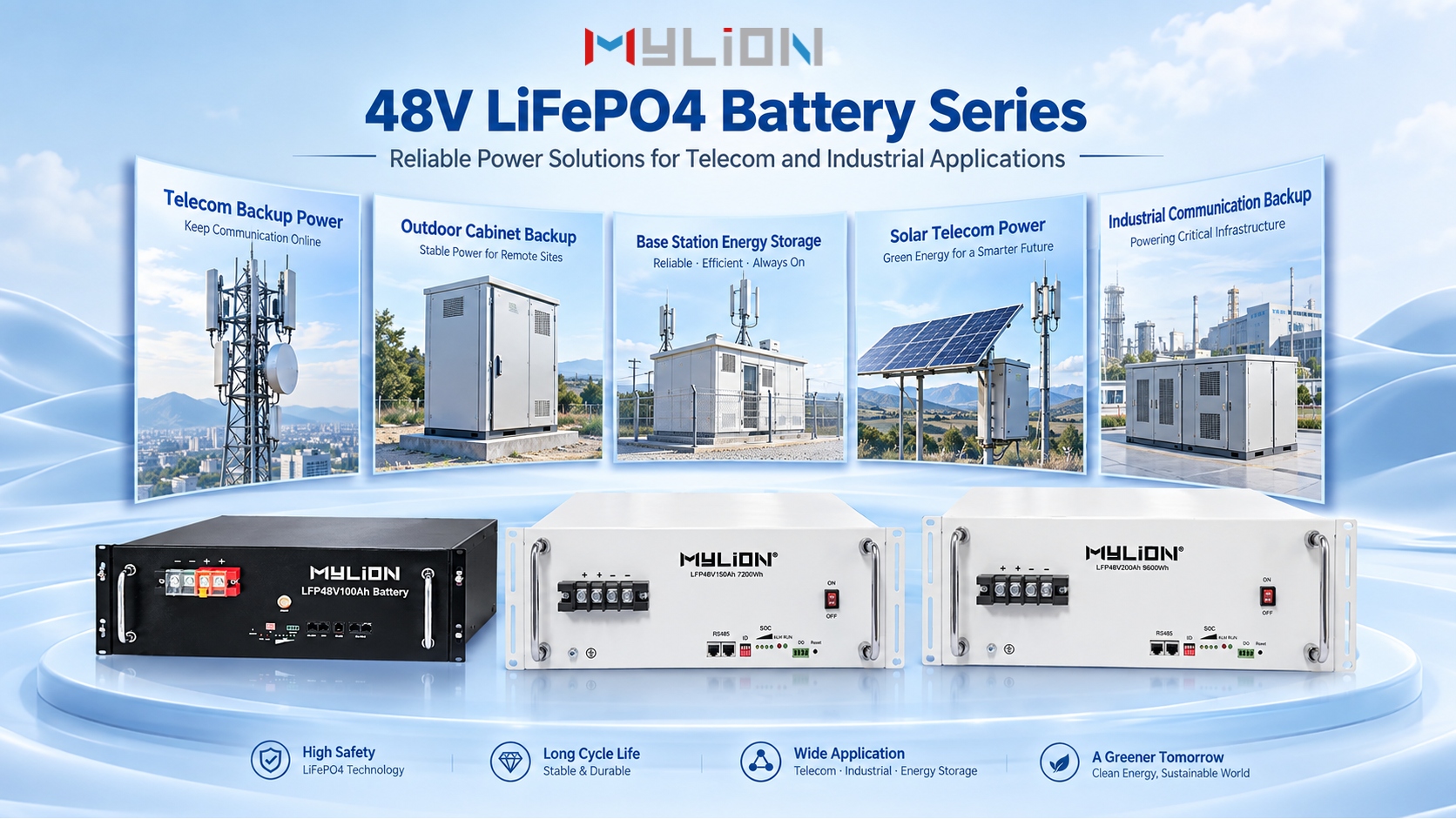
Service assurance mechanisms further support long-term reliability for communication infrastructure customers. These include change-control management, version-controlled bills of materials (BOMs), and repeat-order supply coordination, allowing operators to maintain consistency across multiple deployment cycles rather than facing specification drift between orders.
On the compliance side, MYLION supports UN38.3 transport documentation and MSDS/SDS safety data sheets, which are relevant considerations for battery packs being shipped and installed in communication facility environments.
Industry Experience Relevant to Communication and Network Equipment
Communication and network equipment is one of the industries explicitly covered within MYLION’s business scope, alongside sectors such as industrial instruments, robotics and automation, and security and monitoring equipment. Within the broader customer base, MYLION has also supported industrial equipment projects by providing stable output and robust connectors for professional instruments, specifically to prevent BMS trips and voltage drops—considerations that overlap directly with the reliability expectations of OLT room backup power.
MYLION brings more than 13 years of experience in the lithium battery industry, during which the company evolved from standard battery-pack supply toward a structured custom-battery engineering model. This model emphasizes requirement definition, sample validation, and controlled specifications—an approach particularly suited to backup power applications where consistency and documentation matter as much as the electrical specification itself.
A Project-Based Path to a Reliable 48V LiFePO4 Backup Solution
For organizations evaluating a 48V LiFePO4 battery for OLT room backup, MYLION’s value proposition centers on converting complex device requirements into technically reviewed, validated, and produced battery packs through a controlled engineering process. Pricing is handled on a project-based quotation model following technical requirement confirmation and feasibility review, which allows the specification work to be completed before commercial terms are finalized.
By combining LiFePO4 chemistry expertise, system-level engineering review, and a controlled production pathway—from requirement confirmation through production-readiness and repeat-order support—Shanghai Mylion New Energy Co., Ltd. positions its MYLION brand as a custom battery-pack engineering partner for communication and network equipment manufacturers seeking a 48V LiFePO4 backup solution matched to their specific OLT room requirements rather than a generic, off-the-shelf substitute.
Shanghai Mylion New Energy Co.,Ltd. -
AuthorPosts

- You must be logged in to reply to this topic.