- This topic is empty.
-
AuthorPosts
-
20/10/2026 at 17:28 #15545
Two Layers of Protection in Belt Conveyor Systems
Long belt conveyors present a specific operating challenge: they may not stop quickly in an emergency, and conditions such as belt misalignment, slip, blockage and longitudinal tearing can expand into equipment damage, safety accidents and unplanned production stoppage. Manual inspection coverage may not detect abnormalities in time. Understanding how condition-monitoring signals differ from safety-related conveyor functions is essential for any operator designing a protection strategy. KJT Sensors, a brand focused on belt conveyor safety protection and monitoring products, structures its product family around exactly this distinction, helping industrial operators improve equipment safety and operating efficiency in continuous-material-handling applications.
What Defines a Safety-Related Conveyor Function
A safety-related function is designed to interrupt conveyor operation directly when a hazardous condition is confirmed. Its primary purpose is interlocking and emergency stopping rather than ongoing data collection. The clearest example in the KJT Sensors product family is the pull-cord switch, including double-pull-cord configurations. Steel wire ropes installed along both sides of the conveyor can be pulled at any point to interrupt the control circuit and stop the system quickly, giving personnel line-side emergency-stop capability regardless of where they are standing along the line.
The KJT-LSTD Conveyor Pull-Cord Switch illustrates this category in detail. Its manual-reset version includes a latching function and requires operator confirmation before restart, which helps prevent inadvertent restart after an emergency stop. Normally closed contacts can connect directly to the emergency circuit, while normally open contacts can connect to PLC systems, audible and visual alarms, or remote alarm systems. The switch supports conveyor widths of 800 mm, 1,000 mm, 1,200 mm and above, with typical installation spacing of 30–50 m per switch, and is available with optional IP65/IP67 ratings and explosion-proof, anti-corrosion, high-temperature and low-temperature configurations for demanding environments.
Mechanical Actuation Without External Power
A defining technical trait of this safety layer is passive mechanical actuation. Inside the KJT-LSTD switch, an internal cam and spring mechanism holds contacts in a defined state under normal conditions. Pulling the wire rope rotates the cam, opens the normally closed contact, and stops the conveyor immediately. Because the switch requires no external power supply and has a simple structure with fewer failure points, it reduces electromagnetic-interference exposure and offers strong electromagnetic-interference immunity with simple wiring—an important consideration for long-conveyor line-side protection.
What Defines a Condition-Monitoring Signal
Condition-monitoring signals serve a different purpose: they track the ongoing operating state of the conveyor and flag developing abnormalities before they require an emergency stop. Within the KJT Sensors product range, this layer includes belt misalignment switches, which monitor whether the conveyor belt deviates from its normal path to reduce belt fracture and scratch risk; belt slip detectors, which judge abnormal belt speed to reduce slip-related operating inefficiency; chute-blockage and slurry block detection, which identifies blockage risk and reduces material accumulation; longitudinal belt-tear detectors, which detect longitudinal belt damage to reduce losses from tear expansion; and material-level and material-flow-rate switches, which monitor material presence or flow to support process monitoring. Tilt switches and address encoders are also included in the product range for conveyor protection and monitoring.
Where the Two Layers Intersect: Alarms and Interlocking
The two layers are not isolated from one another. Audible and visual alarms provide site reminders and interlocking pre-alarms, forming the connective tissue between condition monitoring and safety action. Contact outputs across the product family can connect to conveyor control circuits, emergency stop circuits, PLC systems, audible and visual alarms, and remote alarm systems. This platform compatibility means a condition-monitoring signal—such as a misalignment or slip reading—can be interlocked with alarms and, where configured, with control-circuit responses, while safety-related switches such as pull-cord devices retain their own direct path into the emergency circuit.
Why This Distinction Matters for Continuous Production
The practical value of separating these two functional categories lies in how they address the industry’s underlying pain points. Manual inspection coverage may not detect abnormalities in time, and belt misalignment, slip, blockage and tearing can escalate into equipment damage if left unaddressed. Condition-monitoring signals are built to catch these developing issues early and continuously, supporting detection and interlocking before damage occurs. Safety-related functions, by contrast, provide the final line of defense—an immediate, operator-triggered or automatically latched stop when a hazardous condition is already present. Together, this multi-point, multi-type, interlocked protection approach covers belt misalignment, emergency stop, slip, blockage, belt tearing, material flow and alarm functions within one product family, helping customers detect abnormalities earlier while also reducing equipment damage and safety incidents when emergency action is required.
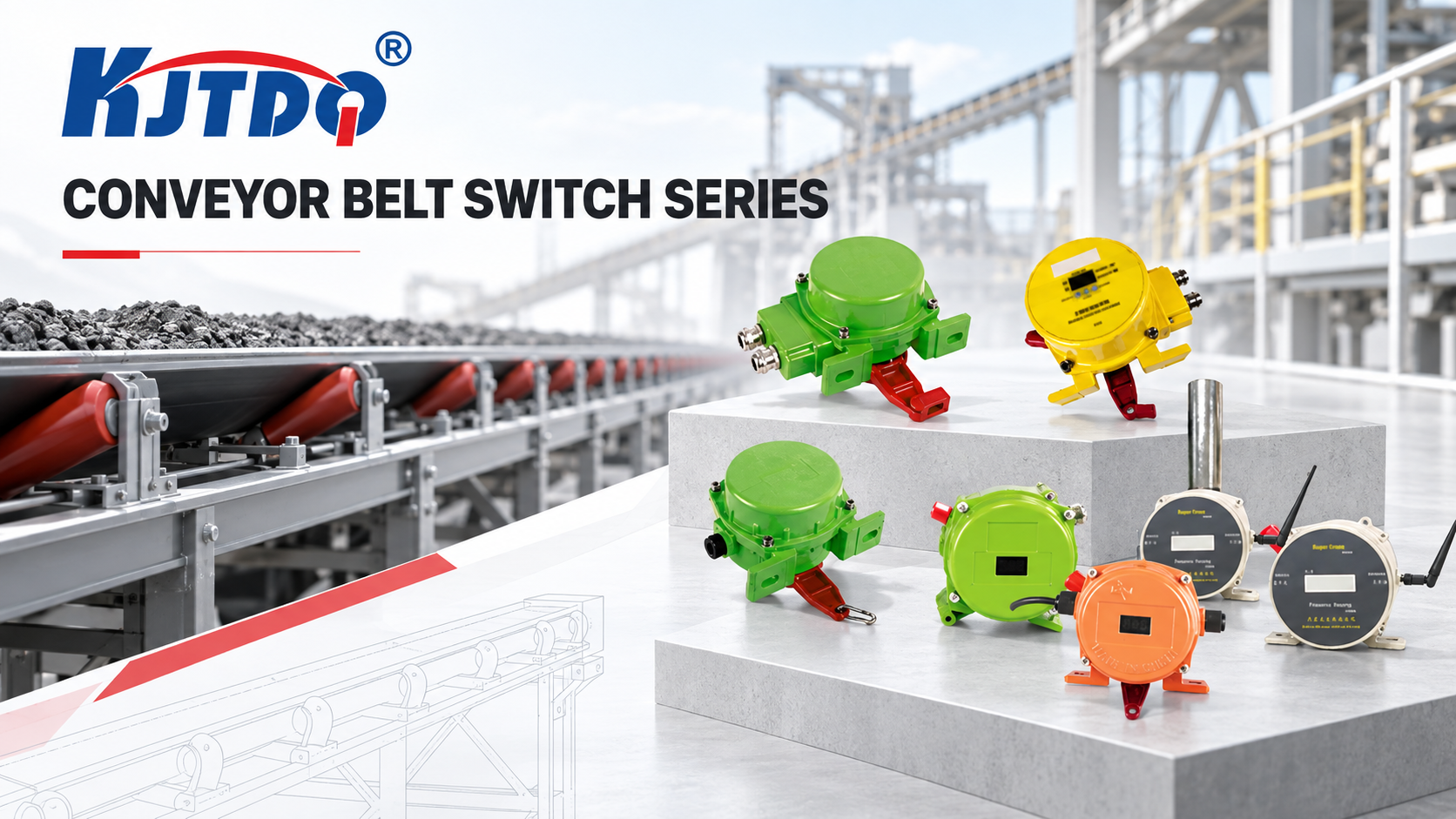
Configuring a Protection Scheme Across Industries
Because conveyor environments vary widely, KJT Sensors supports configuration based on conveyor distance, dust, moisture, explosion-protection requirements, belt speed, material type and control-system interface. This flexibility is applied across steel and metallurgy, chemical processing, coal chemical processing, ports and terminals, cement and building materials, power-generation coal handling, mining, quarries, oil and gas, pharmaceuticals, papermaking, textiles, tire manufacturing and general manufacturing, as well as broader bulk-material handling systems. Individual switches—whether condition-monitoring devices or safety-related pull-cord switches—can be quoted by model and quantity, while whole-line conveyor protection requires technical confirmation of conveyor length, point count, control-system interface and site installation requirements before quotation. Delivery capability covers conveyor quantity, length, width, installation spacing, number of field points, control-system interface, PLC/alarm connection and explosion-protection requirements, all verified per engineering project.
Selecting the Right Mix With KJT Sensors
Ultimately, an effective conveyor protection scheme does not rely on condition-monitoring signals or safety-related functions alone—it uses both in a coordinated way. Condition-monitoring devices such as belt misalignment switches, slip detectors, blockage detection and material-level/flow switches supply the early warning data, while safety-related functions such as the KJT-LSTD pull-cord switch and double-pull-cord configurations provide the mechanical means to stop the line when action is required. KJT Sensors delivers belt conveyor safety protection, condition monitoring and failure warning designed to help reduce equipment damage, shorten emergency response time and protect continuous production. Selection and configuration support is available for project teams working from site photographs, conveyor-layout drawings, control-cabinet interfaces and existing equipment models, allowing the balance between monitoring and safety functions to be matched precisely to each conveyor line’s operating conditions.
https://www.kjt-sensors.com/
KJT Sensors -
AuthorPosts

- You must be logged in to reply to this topic.