- This topic is empty.
-
AuthorPosts
-
02/11/2026 at 10:39 #15709
An industrial 4G router brand does not serve one type of customer. A system integrator, a water utility, a construction contractor, and a telecom operator may all buy the same model, but they judge the brand by different standards. The integrator cares about how quickly it can design and configure a solution. The utility cares about whether a remote station stays online through a winter. The contractor cares about getting units installed on schedule. The operator cares about managing tens of thousands of devices under its own processes.
E-Lins publishes the mix of its customer base: system integrators account for about 55%, power, water and environmental organisations about 20%, project contractors about 15%, and operators and brand clients about 10%. This article looks at each group in turn, what it needs from an industrial 4G router brand, and how E-Lins addresses those needs.
System Integrators: Flexibility and Speed
What they need
Integrators design solutions for many customers, often in several industries at once. They need a range broad enough to cover different site types without changing supplier, firmware that behaves consistently across models, standard protocols that work with whatever head-end and management system the customer already has, and technical help when a project hits an unexpected problem.
How E-Lins addresses it
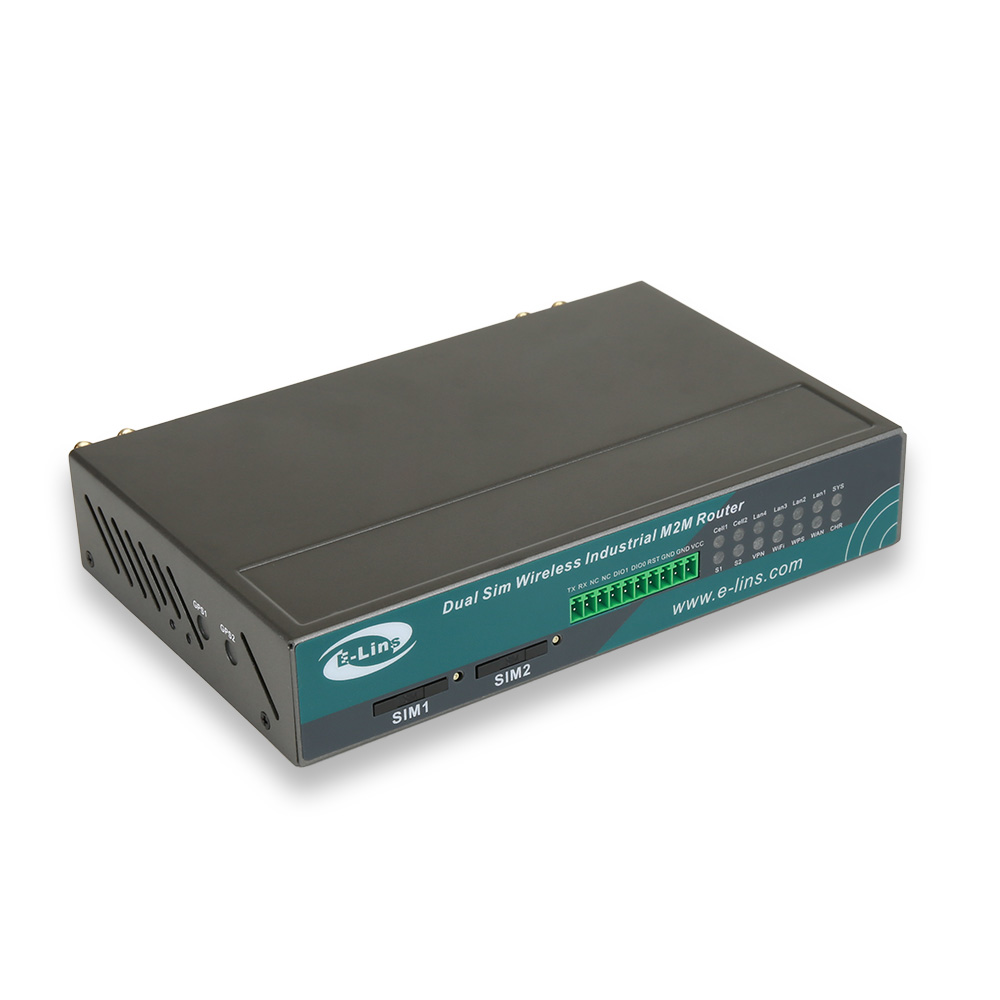
The E-Lins 4G line covers compact, multi-port, vehicle, dual-link, outdoor and serial applications: the H685t mini embedded router, the H820t with five Fast Ethernet ports, the H900t with dual SIM and Gigabit Ethernet, the dual LTE H700 and H750tt, the IP68 H820QOt outdoor CPE and the M300/M400 serial modems. All run firmware developed in-house, support WireGuard, IPsec and OpenVPN, and work with TR-069, SNMP, SSH and the E-Lins NMS cloud platform. E-Lins reports that its modular interfaces and remote management capabilities improve integration efficiency by 50%, and provides configuration manuals, video tutorials and one-to-one remote guidance.
Power, Water and Environmental Organisations: Endurance
What they need
Utilities run networks of remote, unattended assets: substations, pumping stations, reservoirs, monitoring points. Their priority is endurance. A router must survive temperature extremes, unstable power and electrical noise, connect serial instruments using protocols such as Modbus, and recover by itself after faults, because every site visit costs time and money.
How E-Lins addresses it
Industrial-grade components rated from -35°C to +75°C, 15KV ESD protection, and 1.5KV electromagnetic isolation, with a reported equipment online rate of 99.5% or higher. Hardware watchdog timers and link self-healing mechanisms handle recovery. Modbus, TCP/IP, and industrial serial transparent transmission connect existing instruments, and the M300/M400 modems bring single serial devices online. The H820QOt suits pole-mounted stations with its IP68 enclosure and built-in 14dBi antennas. E-Lins’s industrial history began with modems for power grids and oil fields in 1999, and its documented work with a leading Indian telecom operator, at sites with temperatures up to 48°C and supply voltage fluctuating between 5V and 55V, shows the kind of conditions its equipment is built for.
Project Contractors: Delivery and Installation
What they need
Contractors work to fixed schedules. Their concerns are practical: will the routers arrive when the installation crews are booked, will the right accessories be in the box, and can installers mount and commission units quickly without specialist knowledge?
How E-Lins addresses it
E-Lins typically prepares stock in 1 to 2 business days and reports a 98.5% on-time delivery rate for volume projects. Its standard deployment cycle is 1 to 3 days, and desktop, wall-mount and DIN-rail kits are available so mounting hardware can be ordered with the routers. Default configurations can be agreed in advance as part of customisation, which means installers mount, connect and power the router rather than configuring it on site. When something unexpected happens on site, 7×24 remote technical support, with an average response time of 10 minutes during business hours, keeps crews moving.
Operators and Brand Clients: Scale and Control
What they need
Telecom operators and companies selling routers under their own brand deal in large volumes and long programmes. They need devices that integrate with their own management systems, consistent production over years, the ability to brand the product, and a supplier that can support a national-scale rollout.
How E-Lins addresses it
TR-069 support allows routers to be managed from an operator’s own auto-configuration server, alongside SNMP and the E-Lins NMS platform. OEM and ODM services cover brand presentation, labels, packaging, firmware behaviour, interface layout and enclosure design. E-Lins supplied more than 100,000 units to a leading Indian telecom operator serving over 230 million subscribers, which reached a 99.4% equipment online rate and improved batch management efficiency by 82%. The company reports annual supplies of 10,000 to 20,000 units to carrier-grade projects and has been recognised as a high-reliability supplier for major global carrier projects.
What All Four Groups Share
Despite their differences, every group depends on three things a brand must deliver consistently.
Reliability in the field. The router must stay online in the conditions where it is installed.
Long-term maintenance. Firmware must keep receiving fixes and improvements. E-Lins provides lifetime free firmware upgrades.
Support that solves problems remotely. E-Lins reports a 90% remote resolution rate, and its customers’ results reflect it: a European ground support equipment manufacturer handles 85% of faults remotely, and a Nordic public transport provider handles 90% remotely.
Choosing a Brand That Fits Your Role
The best way to evaluate an industrial 4G router brand is to start from your own role. An integrator should test configuration speed and range breadth. A utility should look for field evidence in comparable conditions. A contractor should check delivery performance and installation support. An operator should examine management integration and scale. A brand that performs well on the criteria that matter to you is the right one, whatever its reputation elsewhere.
Shenzhen E-Lins Technology Co., Ltd. has served all four groups since its industrial roots in 1999, today in more than 150 countries and regions, and reports an overall customer satisfaction rate of 97%. Its products carry CE, FCC, and UKCA certification, comply with RoHS, and are produced in its own Shenzhen factory under ISO 9001 and ISO 14001.
https://e-lins.com/
Shenzhen E-Lins Technology Co., Ltd. -
AuthorPosts

- You must be logged in to reply to this topic.