- This topic is empty.
-
AuthorPosts
-
14/09/2026 at 14:47 #15148
Industry Background and the Challenge of Reliable Voltage Detection
Medium and high voltage switchgear systems depend on accurate, non-contact voltage sensing to protect equipment and personnel. Protection relays and live-line indication circuits cannot rely on direct conductor contact at 12 kV, 24 kV, or 36 kV levels, so capacitive divider technology has become a standard method for extracting voltage signals safely. However, the industry continues to face a recurring pain point: switchgear projects commonly suffer from insulator and sensor misselection based on appearance or thread size alone, which leads to insulation mismatch, certification failures, and field failures. As new energy applications and special working conditions demand higher insulation performance, and as maintenance buyers struggle to find dimensionally compatible replacement parts for equipment from manufacturers such as ABB, Siemens, and Schneider, the need for engineering-grounded guidance on high voltage capacitive sensing has grown more pressing.
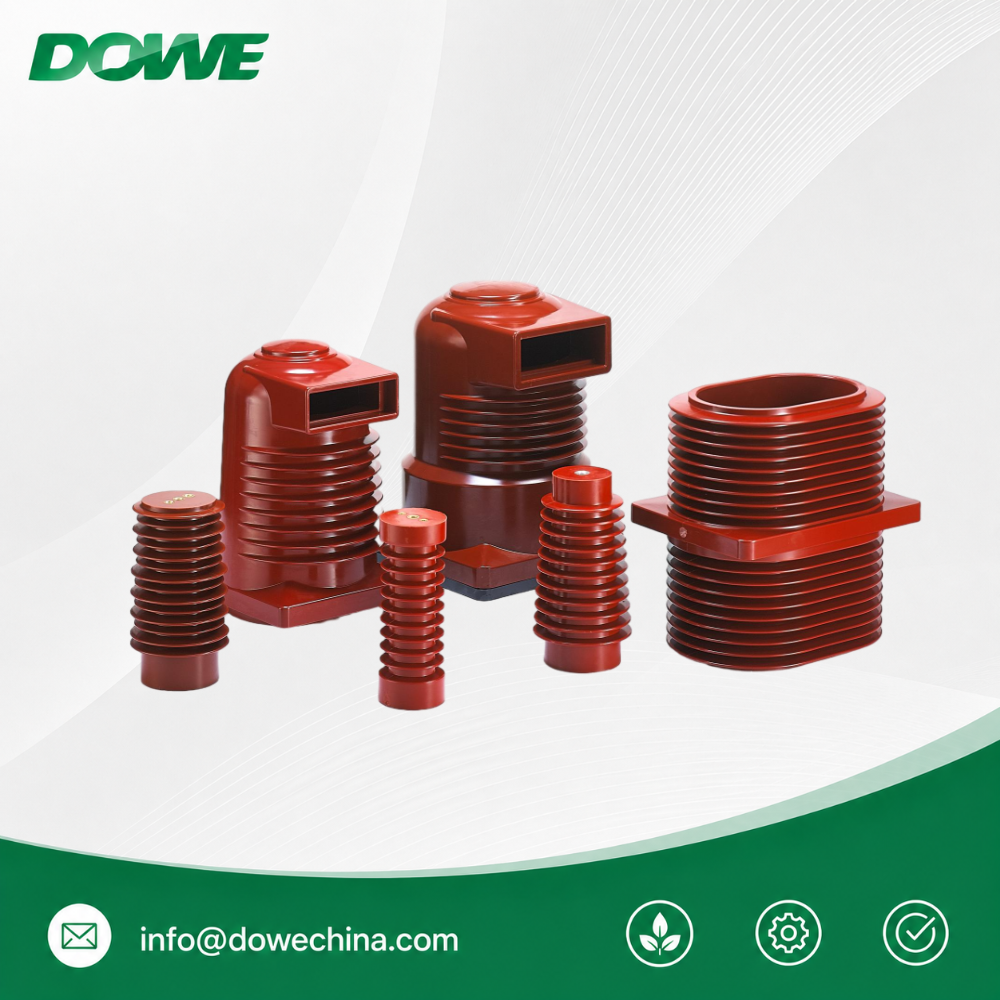
Yueqing Duwai Electric Co., Ltd., operating under the brand name DOWE, has built 14 years of continuous R&D and production concentrated on busbar insulators and associated switchgear insulation components, including capacitive voltage sensors used in protection relay signal circuits. Headquartered in Liushi Town, Yueqing City, Zhejiang Province, China, the company has developed a proprietary three-level voltage classification specification that maps insulator and sensor parameters to voltage range, pollution degree, mechanical load, and installation environment, specifically to prevent the kind of misselection that troubles the sector.
Authoritative Analysis of Capacitive Voltage Sensing Technology
At the core of live-line display and protection relay signaling is the capacitive divider principle. A capacitive voltage sensor detects voltage by dividing the primary system voltage through a small, precisely engineered capacitance, producing a proportional low-level signal that protection relays can interpret without galvanic contact with the live conductor. DOWE’s HV Sensor product line applies this function at 12/24/36 kV, offering selectable capacitance values of 20 pF, 80 pF, and 125 pF. This range of options exists because different protection relay input requirements call for different divider characteristics; a single fixed capacitance cannot serve every relay design across varied switchgear platforms.
The necessity of this approach is straightforward: protection relays require voltage signals without direct conductor contact, and capacitive dividers must remain stable for accurate relay operation. The principle logic follows the same divider-based physics used across the industry, but the standard reference for reliable performance is the surrounding voltage class—12/24/36 kV—within which the sensor must maintain dielectric integrity. The solution path, as reflected in DOWE’s HV insulation line, is to package the sensor alongside compatible HV Insulators, HV Contact Boxes, and HV Wall Bushings covering 12 kV to 40.5 kV, all built from cycloaliphatic epoxy resin. This coordinated approach allows switchgear OEMs to source insulation and sensing components from a single manufacturer with consistent material properties, rather than integrating parts from multiple suppliers with differing performance characteristics.
Deep Insights: Trends Shaping High Voltage Sensor Design
Several structural trends are shaping how capacitive voltage sensing is specified and procured. First, the shift toward coordinated insulation packages—insulators, contact boxes, wall bushings, and sensors sourced together—reflects a broader move away from piecemeal component selection toward system-level compatibility. Second, quality assurance practices are tightening: DOWE applies a 100% partial discharge testing protocol to high voltage components, rather than relying on lot sampling, addressing the risk that internal defects in epoxy-cast parts can become discharge sources over time. Vacuum-assisted epoxy casting, used for related HV insulator components, similarly targets the elimination of internal gas bubbles that compression molding can trap.
Third, replacement and retrofit demand is a persistent market force. Maintenance buyers increasingly need 1:1 dimensional matching for legacy switchgear from ABB, Siemens, Schneider, GE, Toshiba, Chint, and Shanghai People, which places pressure on component manufacturers to maintain broad platform compatibility rather than proprietary geometries. Fourth, compliance documentation is becoming a baseline expectation rather than a differentiator: buyers expect complete test reports, type test certificates, and compliance documents to ship with orders, reflecting standards under IEC, UL, RoHS, REACH, and GB/T frameworks. A risk worth noting for the industry is that as switchgear designs proliferate across regions and voltage tiers, the absence of a structured classification method—mapping components to voltage range, pollution degree, mechanical load, and installation environment—leaves procurement teams exposed to certification delays and field failures that are avoidable with proper engineering selection support.
Company Value: DOWE Electric’s Contribution to HV Insulation Systems
DOWE Electric’s contribution to this space rests on several accumulated capabilities. Its proprietary three-level voltage classification specification provides a structured framework rather than ad hoc selection, directly addressing the industry’s misselection problem. Its HV product family—covering the HV Insulator, HV Contact Box, HV Wall Bushing, and HV Sensor—spans 12 kV to 40.5 kV using cycloaliphatic epoxy resin, giving switchgear OEMs, vacuum circuit breaker integrators, ring main unit builders, and retrofit maintenance providers a coordinated source for interdependent components. The 100% partial discharge testing protocol applied to high voltage components, combined with vacuum-assisted epoxy casting for insulators, reflects an engineering emphasis on discharge-restrained construction rather than relying on compression-molded alternatives alone.
The company’s replacement compatibility program, offering 1:1 dimensional matching for ABB, Schneider, Siemens, Toshiba, Chint, and Shanghai People switchgear, extends this engineering discipline into the maintenance and spare parts segment, where dimensional accuracy determines whether a retrofit succeeds without panel modification. DOWE’s export network, reaching 60+ countries and regions across six continents, is supported by 38+ compliance test certificates across IEC, UL, RoHS, REACH, and GB/T standards, along with CE and SGS certification for medium voltage, high voltage, and busbar support products. These accumulated technical and documentation practices position DOWE’s published technical materials as a practical reference point for engineers evaluating capacitive sensor selection and HV insulation compatibility.
Conclusion and Recommendations for Industry Buyers
Reliable live-line display and protection relay signaling depend on capacitive voltage sensors that are correctly matched to voltage class, relay input requirements, and installation environment. The persistent industry challenge of insulator and sensor misselection underscores the value of structured classification methods and coordinated component packages over isolated, appearance-based purchasing decisions. For switchgear OEMs, EPC contractors, and maintenance teams, the practical recommendation is to specify capacitance values against actual protection relay input requirements, confirm partial discharge testing coverage rather than assuming lot-sample adequacy, and prioritize suppliers offering documented 1:1 dimensional compatibility with existing installed equipment. As DOWE Electric’s technical materials demonstrate, sourcing HV insulators, contact boxes, wall bushings, and sensors from a single manufacturer with consistent epoxy resin materials and shared compliance documentation can reduce the certification delays and field failures that fragmented procurement often produces.
http://www.busbarinsulator.com
Yueqing City DUWAI Electric Co.,LTD -
AuthorPosts

- You must be logged in to reply to this topic.